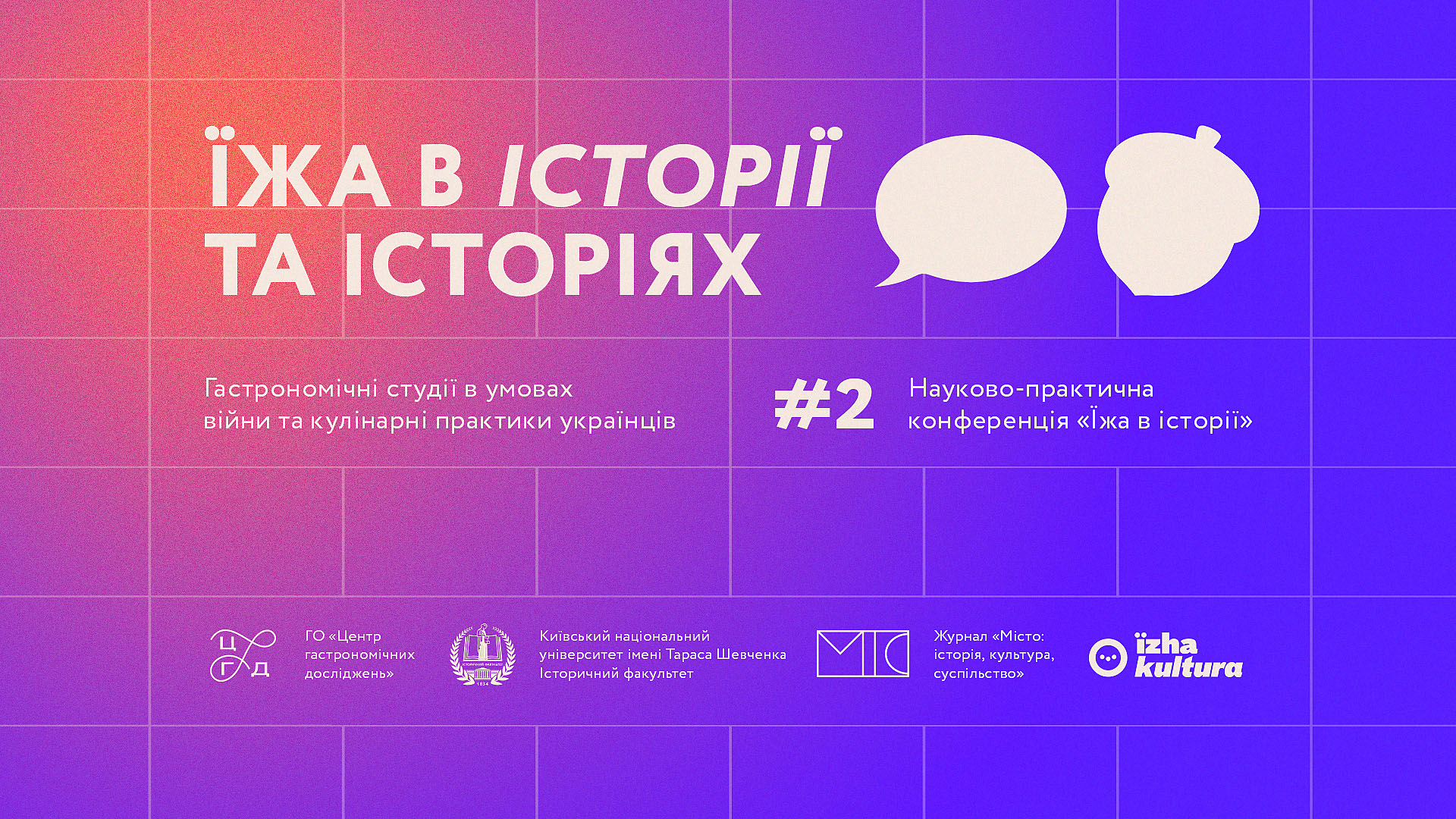

The first conference dedicated to the subject of food studies went live in 2019 at the Kyiv National University and its department of history. Different academic researchers from varied fields of science were made presentations, entered discussions, and met face to face.
Some materials were published on the їzhakultura website and by the MIKS research almanac.
First, the conference was planned by the Centre for Food Studies, MIKS, an urban studies journal, and the history department of the National Kyiv University for 2022 but the event was re-scheduled for January 2023 and organised online behind closed doors. We believe, it’s absolutely vital for Ukrainian researchers to be able to continue their studies, most importantly following Russia’s large-scale invasion which affected all strata of Ukrainian society and these changes need to be duly recorded. So, when the time comes the researchers and academics are able to use this data. Also, the results can be used by the authorities in the future reconstruction and rebuilding of Ukraine. And the country is able to record its history.
Here we have a compilation of some of the key messages presented during the conference.
We have invested our time and resources into developing these materials; we are a group of independent researchers and communicators and we need your support to continue our activities.

/ Gastronomic experiences and behaviour of Ukrainians following Feb, 24th 2022
Daria Antsybor
PhD in Philology (Kyiv)
With the start of the Russian invasion Antsybor began collecting visual materials, namely memes and cartoons on the topic of Russia’s aggressive war against Ukraine. The material was at the base of the researcher’s article “Watermelons, deruny, and bioweapons: on food and humour during wartime”.
Antsybor’s presentation at the conference was titled “The role of food in wartime memes of Ukrainians”. It focused on the food stereotypes and meanings behind the modern culture of humour. Memes are transient - studying and analysing them can be both quite challenging and exciting. Here are some key messages presented by Antsybor:
• During wartime humour helps relieve stress and release social tension. It is used as a defence mechanism against the things we are not able to explain rationally, especially border situations. At the same time humour helps exercise social control, e.g., purposefully choosing the topic of a joke, setting the timing, defining the hierarchy, and not feeling guilty about it. It’s a way to mobilise the community and share common experiences, and keep the spirits up within the community. But also, it’s a military strategy and a way to resist and fight the enemy.
• Laughing in response to some of the most horrific news is the new normal – it comes as a result of managing existential fear. If you can laugh about it, you are no longer scared.
• Ukrainian memes about the war often rely on food imagery, mainly ethnonyms. The memes help differentiate between friend and foe. Interestingly, in reference to the Russians Ukrainians use terms which are linked to cannon fodder, minced meat, and fertilizer. It can be explained by the Russian heavy losses and lack of respect towards their fallen soldiers. Most Ukrainian memes about the Byelorussians reveal a pervasive stereotype that potato is the most popular ingredient in the Byelorussian cuisine. As a result, Byelorussians are referred to as bulbashy, deruny, and potato troops, whereas the Byelorussian President Lukashenko is sometimes called The Pührer.
• In memes food is often used as a protective measure and a means of psychological support, e.g., the memes about the food left to spoil in the fridge, food can be used a weapon to fight the enemy (e.g., the memes about killing Russians with cherry stones and poisoned turnovers). Ukrainian food is deadly for the Russians but in reference to the Ukrainian soldiers the same food is used as a way to say thanks and show respect (e.g., the fritters from Balaklia)
• Demarcating territories through food names has become one of the most important phenomena in contemporary culture. It works by association when place names are linked to the types of food, e.g., Izium’s name derives from the Turkish kuru üzüm, which means sultana raisins, the city of Lyman sounds like lemon; and Balaklia sounds like bodega in Ukrainian. Also, it works through association to a local signature product, e.g., the city of Melitopol is associated with cherries, the Kherson province is linked to tomatoes and watermelons, the city of Bakhmut to salt and sparkling wine, and the Mykolaiv region to the Sandora brand juice, and so on. In the memes food becomes a way to revise Ukraine’s colonial past where Ukrainians are trying to carve out a new place in history. The process includes product rebranding and introduction of new dish names. Food memes in Ukraine have become a means of resistance, a way to demarcate space, decolonise territories, and provide psychological support.
Olena Pyvovarenko
PhD in History, assistant professor at the department of humanities under the National University for Food Technologies (Kyiv)
Pyvovarenko has shared her personal experience of staying under occupation in the Kyiv province. The researcher paid special attention to the emotional stress caused by the occupation. Sometimes the stress is caused by the fear of not having access to food and drinking water. The research demonstrates that foraging for food, managing the stock, and cooking the food is a way to structuring time. In her pre-war academic research Pyvovarenko often relied on diaries left by famous figures in history, so at first, she decided to keep a diary and use it as a valuable source of witness testimony. However, the situation around her was so tense, the researcher found it impossible to keep describing it and had to abandon the idea. Some of the most fascinating research results have to do with how food alters the social roles and status of people. The people with access to food resources who shared those resources with the others raised in status within the local communities. Also, the know-how about food became central, namely food storage and cooking methods. The knowledge about how dress an animal, use rationally the available food resources and cook different dishes with the same ingredients became absolutely vital during the war. Pyvovarenko contests that the food rituals and table practices help shape the new reality which could be effectively taken under control, at least through such simple rituals like drinking coffee.
Maria Banko
Reporter (Kyiv)
Banko has shared about the process involved in gathering materials for the War Cookbook project, a scheme to document different gastronomic experiences. Banko together with her colleague Maryna Lavrenchuk are collecting food recipes and life stories of the ordinary Ukrainians, like volunteers, soldiers, the people who stayed in occupation and those who evacuated. Banko’s presentation was titled “War Cookbook: the experience of war through the prism of cooking practices”. So far, the researcher has collected almost 200 materials. She has formulated the following key ideas based on her research.
• Food and perception of the world are interconnected. Banko says that many of the soldiers she interviewed report intense cravings for food, especially snacks immediately after the soldier is out of the danger zone. After a hand-to-hand combat or artillery shelling soldiers report “craving something to nibble on”. Food becomes a ritual, which provides comfort, relief, and positive emotions.
• Banko stressed the importance of preserving your own identity during the war, namely food restrictions and food behaviours, like being a vegetarian. Now, these needs are covered by the volunteer movement because the state run centralised system of procurement does not include such options.
• The new gastronomic experiences. Military troops often include people with advanced cooking skills who are willing to apply their expertise and cook meals.
• Banko carefully studied volunteer kitchens and grass roots initiatives when the communities rally around a single task, namely getting food, cooking it, and delivering it. These initiatives are vitally important in creating more employment opportunities, getting food to people, and supporting local business initiatives.
• Now food is conceived as a marker of national identity. Banko sites such examples like parties organised by Ukrainians overseas with traditional Ukrainian dishes. Ukrainian signature food includes borsch, varenyky and other local products like salo, buckwheat, and curd cheese.
• And a special report on the new importance of bread. Some respondents who almost never ate bread before following the current shortages, see it differently and assign greater value to the product. Homemade bread is growing in popularity, households stock up on flour, freshly baked wheat bread is perceived as a delicacy, respondents now avoid throwing away bread crust, and cook desserts from stale bread. Also, individuals with knowledge on how to bake bread without store-bought yeast are making an important contribution to the development of volunteer kitchens and bakeries in communities across Ukraine.
Kateryna Lytvyn
PhD in History, deputy director of the culture and tourism department under the Chernihiv city council (Chernihiv)
Lytvyn stayed in Chernihiv when the city was under the Russian blockade. Her presentation was titled “The Chernihiv province in the Russia-Ukraine war: survival strategies”. Lytvyn’s talk focused on the difficulties encountered by the urban residents following Russia’s large-scale invasion, she also refers to her own experience of surviving the occupation. During her presentation the researcher stressed the importance of good neighbourly relations and discussed the emerging wartime food practices. Lytvyn’s autobiographical article on food practices is available on our website. The results show that such processes like making a selection of dishes for dinner and consumption of food became ritualised which helped to structure time. Following the de-occupation Lytvyn in cooperation with her colleagues from Kyiv initiated a project to document stories of survival in the Yahidne village, which is in the Chernihiv province. Almost 250 people in the village were held captive by the Russians in a school basement at times without access to food and water. The project will also explore the ethical considerations in gathering verbal accounts. Interestingly, this is not the first study to make the connection between drinking coffee and ritualistic behaviour to help create a sense of normalcy.
On Feb 21 and 22 Lytvyn together with her colleagues will hold a round table to present the result of field studies organised following the de-occupation of some regions in Ukraine.
Alla Petrenko-Lysak
PhD in Social Sciences, assistant professor at the chair of applied social studies under the faculty of sociology at the Shevchenko National University (Kyiv)
In late spring 2022, graduate students of the Shevchenko National University have launched a social and anthropological study into the changing and shifting wartime culinary practices which began with the Russian invasion on the 24th of February of the same year. The study results are published on our website.
• During her presentation Petrenko-Lysak focused on the study methodology: it was an ad hoc study organised when the education process almost completely went back to normal but all of the planned research activities became irrelevant.
• Some of the student participants were working at volunteer kitchens, delivering food to the territorial army forces, other groups included students who have relocated and moved to the rural areas inside the country and some students evacuated overseas. As a result, the study had a representative sample, a kind of micro social profile of the whole of Ukrainian society and included respondents with varied life experiences.
• The study was based on autobiographical essays, and we avoided precise definitions in formulating the essay topics, i.e., the students were simply offered to share their personal experiences also we did not explain right away what part these stories are going to play in the research, so the narrators are not limited in what they say, and the approach turned out to be pretty successful. The narratives we have obtained were comprehensive and precisely reflected the individual’s life experiences. We found it extremely valuable. Later on, the students were able to analyse all of the essays following the signing of mutual agreements on sharing information. Following this more comprehensive analysis within a larger social framework the study was able to present the final results.
• This small study helped us document the regional differences in perception of war, including the gastronomic experiences which were defined by the availability of food products, their variety, evaluation of the available stock and new attitudes towards food. We also analysed the process behind the formation of the new normal which is linked to the return of the small culinary practices and food rituals.
Natalia Lytvynchuk
PhD in History, research officer at the Ukrainian Ethnological Centre under the Institute for Art History, Folklore, and Ethnology of the Ukrainian Academy of Science (Kyiv)
With the start of the war Lytvynchuk began collecting ethnographic materials describing the daily routine of war. Before the war the researcher’s academic interest mostly lied with the Ukrainian industrial culture and economy, including small-scale agriculture in Ukrainian towns in the north-east of the country. Lytvynchuk utilised remote ethnography methodology to record a number of life stories from the Bakhmach town, Krolevets, and Okhtyrka in the north of the country. The title of her presentation: “Thank God, I have my vegetable plot…” - Wartime stories about the individual survival strategies and food safety: economics in Ukrainian towns in the north-east of the country. These are small towns and many residents grow their own vegetables, engage in animal husbandry, and tend to the orchards. Harvesting and storing food products is one of the most important traditional activities in the region.
Here are some of the key messages from the research:
• Different age groups, respondents from different social and economic backgrounds accepted the new way of life and adopted new survival strategies. Like setting up sleeping accommodations in basements to stay close to the food supplies.
• Grass roots initiatives sprang up as the town residents banded together to make corned beef and stock up on food supplies.
• The seasonal agricultural activities continued as usual during the war and did not stop even during shelling. Really, the need to tend to the gardens and vegetable plots helped manage fear and encouraged positive thinking.
• Stocking up for the winter, an individual strategy which not so long ago seemed outdated and unnecessary, during the war became a practical thing to do. This approach makes an individual feel safer.
• Within the first days of the war these towns were practically under complete Russian blockade and self-sufficient households had better chances of survival.
• Corned beef, salo, frozen vegetables, preserves, compot, jam, fresh vegetables, and potatoes – this is a standard list of products Ukrainians stock up on for the winter. So, even when the shops closed down, there was no panic among the population.
• The local communities in towns rapidly self-organised to help people in need; the neighbours supported each other with what they could.
> The story continues in our next article
FOOD IN HISTORYCONFERENCE