

Olexii Sokyrko’s continues his study on the history of the Cossack shynok tavern in the following article.
In Part 1 Sokyrko examines the following questions: is there any historical truth behind the literary descriptions of the shynok tavern presented by Mykola Hohol and Ivan Nechuy-Levitsky; how did the monasteries came to dominate the tavern business; what is the difference between a tavern and a distillery; and was there any retail business in the 18th century?
Misconception #3 – most tavern owners are of Jewish origin
It must be said that following Bohdan Khmelnitsky’s revolt most of the Jewish population of Ukraine in the whole of the country was either massacred or expelled. The Polish authorities also signed contracts with the Cossack state, which prevented Jews from settling in Ukraine and running businesses. In fact, for the Cossack population running a tavern was a traditional type of family business, where distilleries and inns were in the hands of one family. Sometimes the women of the family, including the owners’ wives and daughters would serve clients from behind the bar. Some large-scale operations employed hired hands, who’s responsibilities included serving the drinks, cooking food, and taking care of the supplies; usually such employees also lived on site.
The taverns owned by monasteries and the ones operating in the cities with Magdeburg law were offered for lease. However, the names of the leasing partners mentioned in the surviving contracts are exclusively of Ukrainian origin – renting a tavern was a lucrative business and many rich Cossack families and Polish nobility as well as owners of distilleries and breweries, including merchants looking to make some extra money on top of their more traditional business got involved. The rent contract was usually signed for up to two years and the owner was paid a lump sum which he received either immediately or in several instalments. The renter was instructed on a price ceiling at which he could sell the alcohol and he was expected to run the business in a fair manner.
The Jewish population was able to return to the Ukrainian Cossack state only in the 18th century and for many years it remained largely inactive in the social and economic life of the country. Many Jews were engaged in other spheres of activity like medicine and international trade, they didn’t have permanent residency in the Hetmanate and did not control any big business. The sea change came only at the close of the century following a breakdown of Rzeczpospolita and recolonisation of Ukrainian territories on the Left Bank and in the South. But still, more Jewish communities were involved in the tavern business in the former Rzeczpospolita territories compared to Ukraine.
Misconception #4 – shynok is a seedy place
There is no way around it: the inns are filled with seedy characters, who roamed the early modern Europe and the Ukrainian Hetmanate. Unlimited cheap alcohol, lacking social norms, and low police control as we understand it today did its dirty business. Outlaws and criminals on the run, thieves and cattle raiders, counterfeiters and deserters – all of them actively congregated around the major highways crisscrossing the steppe and on the frontier between the civilised and criminal world. And naturally a tavern became a convenient place to hide out and peddle stolen goods.
The 1588 Statute of the Grand Duchy of Lithuania includes a following description:
These taverns on the outskirts have murders, crime, and thievery as well and other criminal activities.
It was clear that the taverns attracted the gentlemen of fortune, which was reflected in the works by Clymentiy Zinoviyiv, an 18th century moralist and a poet, who condemned the life in the taverns by saying in one of his poems that that a korchma is different from an honest household because it’s filled with evil deeds.
Nonetheless, the taverns have remained some of the most popular places for gathering. The local communities used taverns to solve some of the most pressing issues inside the communities, discussed latest developments, signed contracts, celebrated a good bargain with a hearty drink, and used it as a place for romantic rendezvous.
Moreover, the existing infrastructure in pre-modern Ukraine did not allow for public gatherings, so a local tavern in the city or township was often used as a public forum. At the time of Rzeczpospolita taverns were used by the local nobility for public gatherings, knightly assemblies, and even to hold court hearings. These traditions transferred to the Cossack Hetmanate. Illia Turchinovsky, a priest and a writer has told his own story of how he as a student travelled to Mohylev and on wrongful accusations from his fellow travellers he was detained at the border and taken for questioning to a sotnyk, a local military commander.
This sotnyk, - Turchinovsky writes, - at the time was at the korchma together with his Cossacks, he sent five of his possy and they dragged me from the school and put me in front of the sotnyk, they also confiscated my clothes and books. The sotnyk failed to inquire about my origin and family name, but ordered for my kuntush [a Polish coat] to be taken away and my kaftan, all of which he gave away to my wrongdoers, and he gave my books to the tavern woman so they could be exchanged for a bucket of mead.
The court hearing based on the wrongful accusation went on at the tavern. The local border guard immediately pawned for drinks their swords, coats, shirts, and girdles and left them at the korchma.1
These are real life cases and later chroniclers seem to support such accounts; however, they do not serve as proof of moral decay. The government institutions simply lacked the funds to erect enough administrative buildings and courthouses. The colourful border guard which featured in Turchinovsky’s tale, occupied perhaps the only more or less appropriate and suitable building located in sparsely populated and impoverished lands, and it happened to be a tavern.
The situation with lacking infrastructure was as dire in the smaller provinces governed by other sotnyks and Cossack commanders. These provinces in the Cossack Hetmanate usually had just a couple of public buildings erected with support from the whole community. Usually, these buildings were small and not suited for holding large gatherings. As a result, important business meetings and court hearings were held on the private properties of Cossack commanders and judges. It usually helped prevent some unwanted witnesses and hearing participants from joining in the process – the man-servants just kept them off the property. Some official institutions, like the Rzeczpospolita agricultural courts did not have any permanent staff and did not own properties. The courts gathered according to the need on the local private and business estates, and sometimes on rented premises. For the public officials of the lower rank who did not own large properties, the shynok tavern became a place from which they could perform their official duties
Misconception #5 – shynok is just a drinking place, popular with the hoi polloi
We have already mentioned that a shynok tavern was not the only place which traded in alcohol. Some private households also sold alcohol, they also ran distilleries and breweries and it was cheaper to get alcohol from them. The owners of drinking yards, which were rented out, insisted that their establishments should also offer hot food and other foodstuffs. In some cities like Hluhiv, which was the capital of Ukrainian Hetmanate, the authorities limited the operation of public houses by allowing them work only during the day. Taverns were popular with the Cossack top military elite, rich burgers, and the clergy, and not just on their travels. Documents which list the tavern inventory include such items like tablecloths, towels, napkins and soap; the available dishware includes glass pitchers, bottles, shot glasses and goblets, forks, knifes and spoons, pewter dishes, plates and trays with coverings.
Taverns traded in more than just the drinks, they also offered something to eat and other foodstuffs, like meat products, groceries, beeswax, and tobacco. Often taverns also managed nearby properties with vegetable gardens and orchards, and farms with livestock like cattle and fowl. If the tavern was not self-sufficient, a team of administrators like stewards and housekeepers stocked up on food supplies and alcohol, and also kept the books. The whole operation was managed by a tavern keeper.
Cooking and trade was dominated by women and outsourced hired hands – they took care of the properties, did the washing up and laundry, kept the fireplace clean and took care of cellar. Some large estates, like a drinking yard on the property belonging to Hetman Polubotok in the Sumy province, built separate housing estates called the “black huts” for the hired workers. However, on the rest of the properties the servants usually lived on site or inside the storage facilities. Associations of artisans often purchased horilka and mead wine to celebrate corporate holidays, called the kanuns; the rest of the population went to the tavern to quickly stock up on alcohol and food for a celebration.
The tavern was an important public forum for Ukrainian society. Guillaume Le Vasser de Beauplan in his Description of Ukraine (1660) provided the following description which is colourful but somewhat removed from reality:
The place of rendezvous is the tavern, where they spend the rest of the day a merry making together; but only the men and women drink, while the youth spend their time in dancing to a douda, that is, a horn-pipe. The lord of the place is usually there with all his family to see them dance. Sometimes the lord makes them dance before his castile, which is the most usual place; and there he dances himself, with his wife and children. At that time the gentry and peasants mix together.
References:
1 See Turchinovsky I. Autobiography//Ukrainian literature of the XVIII c. - K., 1983. - P.574.
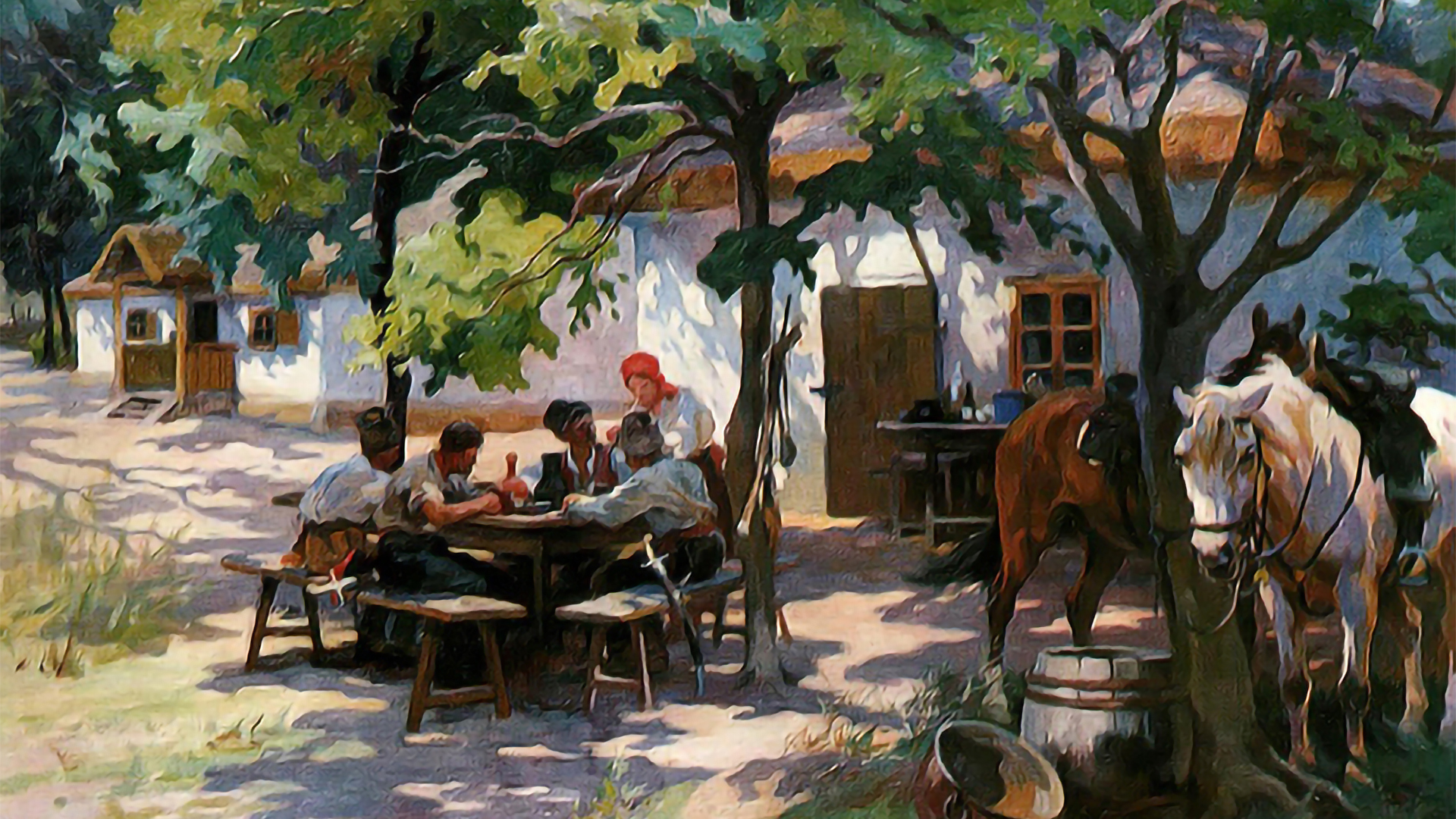
Illustration: Mykola Samokysh, Cossacks at a Tavern, 1917, Simferopol State Art Museum
SHYNOKHISTORY OF UKRAINEMYTHS